

The evolution of the real estate market has always been a topic of great economic and social interest. On this occasion, we will analyze how the price per square meter of housing in the province of Girona has evolved from 2002 to today, comparing it with the evolution of the Consumer Price Index (CPI).
The real estate bubble of 2002-2015
Between 2002 and 2008, Spain experienced one of the most significant real estate bubbles in its history. In Girona, housing prices skyrocketed, reaching historical highs. The factors driving this phenomenon included excessively easy access to mortgage credit, speculation, and overbuilding. After the market shift in 2008, prices began to fall slowly but steadily until approximately the end of 2015.
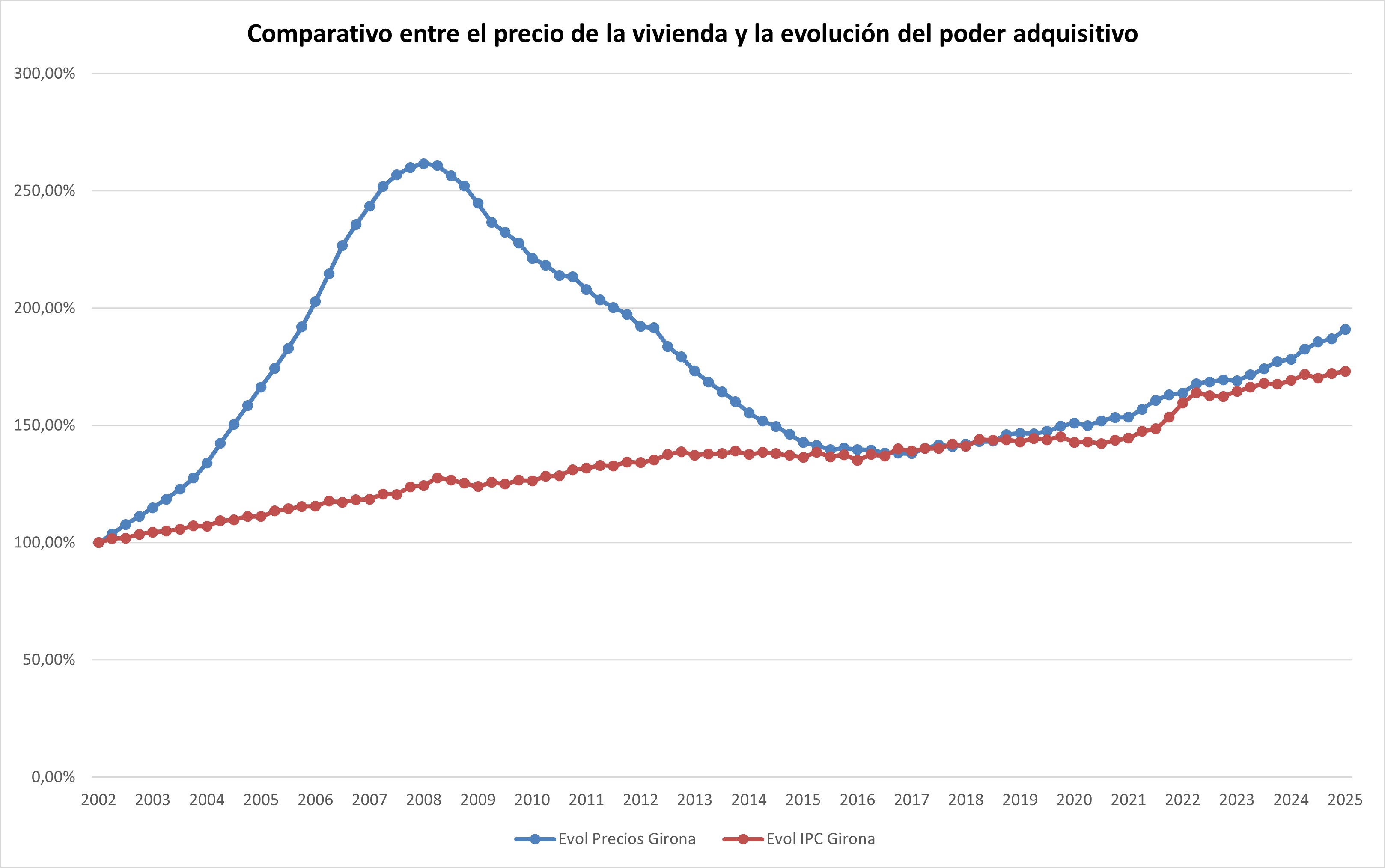
Analysis of price per square meter and CPI between 2002 and today (source Tinsa and Gencat)
As can be seen in the graph, there was a significant disconnection between housing prices and the CPI, reflecting the evolution of household incomes. While housing prices grew uncontrollably, the CPI remained relatively stable, reflecting a moderate increase in the overall cost of living.
Evolution from 2015 to today
From 2015 onwards, housing prices in Girona began to gradually recover. However, this recovery has been much more moderate compared to the boom of the first decade of the 2000s. When comparing the evolution of the price per square meter with that of the CPI, a nearly perfect correlation can be observed, which makes sense as purchasing power should dictate the market price of housing.
Are we facing a new real estate bubble?
The data do not support the idea that we are in a new real estate bubble. Unlike the period 2002-2008, current prices do not show uncontrolled growth nor disconnection from economic fundamentals. Moreover, the banking regulations implemented after the 2008 crisis have restricted access to easy credit, reducing the risk of households becoming over-indebted.
Another key aspect is supply and demand. Although the demand for housing in Girona has increased due to factors such as interest in homes in rural areas after the pandemic, supply has remained relatively stable, avoiding a significant imbalance, as demonstrated by the number of closed transactions in 2024, which remains around 13,500, similar to 2023, and not far from 2022, the historical maximum since 2013 with 14,700 closed transactions.
Is a significant drop in prices likely?
While prices have shown a slight uptick, current market conditions make a significant drop in the short term unlikely. Factors such as economic stability, moderate inflation, and sustained demand back this projection.
Moreover, the current inflationary environment contributes to housing maintaining its value as a safe asset. Investors and private buyers view the real estate market as a secure option amid global economic uncertainty, reinforcing price stability.
The analysis of the evolution of the price per square meter in Girona compared to the CPI from 2002 to today yields a clear conclusion: we are not facing a real estate bubble as experienced between 2002 and 2015. Although prices have shown a slight increase, this phenomenon reflects a more stable and healthier trend. Likewise, current market conditions make a significant drop in prices unlikely, thus consolidating a stable outlook for the real estate sector in the province of Girona.
